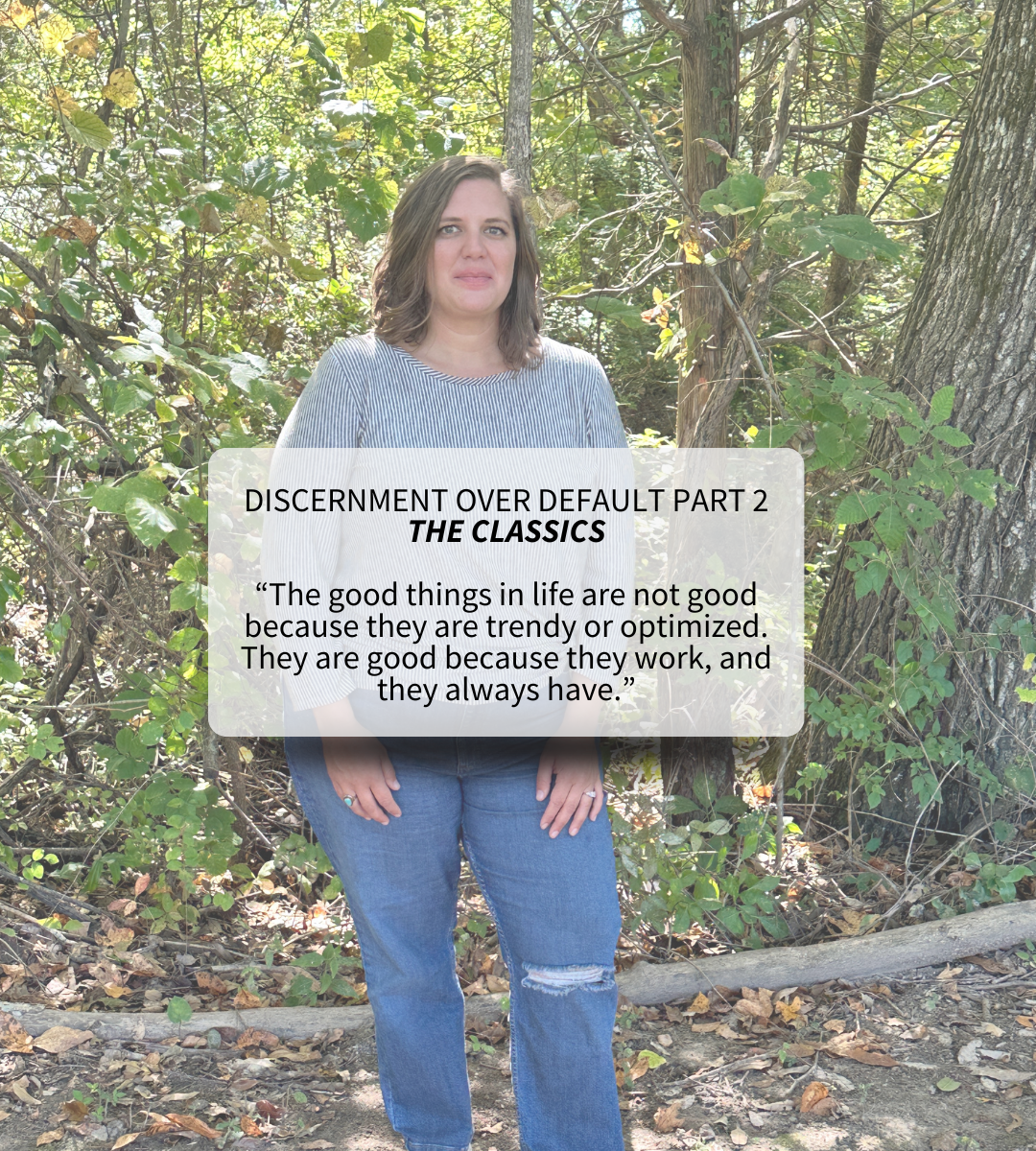
Discernment Over Default (Part II) , Reclaiming the Classics
The good things in life are not good because they are trendy or optimized. They are good because they work, and they always have.
This is the fourth in a small series where I’m laying out how I actually work and some universal truths I’ve discovered on my healing journey. Not trends. Not quick fixes. This is a way of understanding yourself that’s grounded in biology, nervous systems, real life, and nature.
In the first two posts, we talked about your true nature as a human animal. Instincts. Drives. Patterns that exist because you have a body, a brain, and a nervous system shaped by time and experiences. It's about becoming aware of why you are the way you are. These next few blogs focus on choosing what you want to keep, toss, or change about your way of being.
RECLAIM THE CLASSICS
How did we get here, and do we like where we are?
Modern life is not just busy; it is incessantly loud, keeping the nervous system constantly braced. We are flooded with information, comparisons, optimization strategies, and subtle messaging that make us feel we are just one upgrade away from being enough.
Even when we recognize how overwhelming this pace is, many of us still feel compelled to grow faster, always push for better results, and refine ourselves again. The pressure does not disappear just because we see it. Awareness alone does not quiet the impulse to keep chasing. Our culture has strong messaging that quietly implies - you are not enough as you are. Truthfully, it is a way to get you to buy more and do more to try to make yourself feel better - the fallout from a capitalist society (I might write more about that later lol).
This creates a strange loop. We can clearly name the exhaustion, the anxiety, and the fragmentation, yet we respond by adding more inputs, more goals, and more self-improvement. When everything feels urgent and important, discernment collapses. We start confusing striving with meaning and upgrades with alignment. In that state, it becomes difficult to tell whether we are choosing consciously or simply defaulting to cultural momentum. The result is a life that looks full but often feels thin. Dang.
Confusion, anxiety, and restlessness are not character flaws; they are predictable outcomes of overstimulation and misaligned priorities. When your environment constantly signals that you are behind, your system adapts by staying alert and seeking solutions to improve. Slowing down can feel irresponsible or even dangerous because it interrupts the rhythm of constant forward motion. Yet paradoxically, speed without clarity only deepens disorientation. When everything matters, nothing truly does.
This is where the return becomes essential. In moments when you can see the noise and still feel pulled to accelerate, the most radical move is restraint. Growth does not always require expansion; sometimes it requires subtraction. To move forward with integrity in alignment with your true nature, you often have to pause long enough to reconnect with what is actually worth moving toward. Less, chosen deliberately, becomes stronger than more pursued reactively.
The invitation of this post is simple but not easy. Take a second. Step out of the manufactured urgency and look at what has sustained human beings long before productivity metrics and digital identities existed. Sunlight, real food, honest relationships, meaningful contribution, and inner clarity are not sentimental ideals. They are foundational goods that have anchored human life across centuries.
Returning to these things is not regression or “opting out” of modernity. It is an act of discernment in a culture that profits from your distraction. When you reorient toward what is biologically and relationally true, you begin to experience solidity instead of spin. You get closer to who you are, and living in alignment is the best thing you can do for your nervous system.
The good things in life are not good because they are trendy or optimized. They are good because they work, and they always have.
A personal note (read now or come back later):
For the last seven years, I have returned to what I call “the basics” as a way to come back to myself and figure out what I actually like, value, and love. Before that, I was caught in a quiet but steady spiral. I went to work, came home, drank too much, ate too much, felt depleted, and repeated the cycle the next day. We did not have kids, so I could maintain the rhythm without much external interruption, but internally I knew something was off.
Spending time with friends who were invested in holistic health and personal development became an unexpected mirror. Their way of living reflected my own habits back to me, and I did not like what I saw. I realized I was not living in alignment with the woman I once imagined I would become. I tried plenty of things to fill the gap I felt inside, but I was still searching outside of myself for something to make me feel whole. The striving never actually touched the root.
Over time, through a healing journey that I am still very much on, I kept circling back to a handful of foundational principles. They are not trendy or revolutionary, and that is precisely the point. These basics transcend time, culture, and spiritual language because they are grounded in how humans are built. When my life starts to feel scattered or out of control, I do not reinvent myself. I return to one of these anchors and begin there.
THE CLASSICS:
Nature
Human beings evolved in relationship with the natural world, not in isolation from it. Sunlight, fresh air, animals, water, and changing seasons naturally regulate our nervous systems. A sunset turning the sky pink or the smell of rain hitting dry earth does more than create a beautiful moment. These experiences reconnect us to cycles that are older and steadier than our current cultural chaos. When we intentionally spend time outside, our problems often shrink back into proportion. Nature gives the gift of perspective - it reminds us that we belong to something stable and enduring.
Nourishing Food
Food is more than fuel; it is information for the body. Meals made from whole ingredients that grew from soil or were raised with care communicate something very different to our systems than highly processed products do. The closer food is to its natural state, the easier it is for our bodies to recognize and metabolize it. What we eat directly influences our energy, mood, and clarity of thought. Choosing nourishing food is about supporting the biological foundation that allows us to function well. If you eat like crap, you’re going to feel like crap. Eating with intention is a quiet but powerful act of alignment and support for your beautiful body.
Genuine Relationships
No level of achievement replaces the experience of being truly known. Deep conversations, shared laughter, and companionship regulate the nervous system. Status and productivity cannot do that kind of heavy lifting. Relationships provide context for our lives and remind us that we are not meant to operate as isolated units - humans are a social species, and it helped us survive. When the world feels loud and fragmented, genuine connection brings coherence and warmth we all need as humans. Prioritizing people over performance and achievements strengthens the fabric that holds us steady. Meaning is built in moments of presence with other people. You can always strive for more, but do you have people to share it with that you love and who love you?
Contribution
Human beings are wired not only to receive but to give. Contributing to others, even in small ways, creates a sense of belonging and purpose that consumption never satisfies. Acts of service, generosity, and participation connect us to something larger than individual ambition. When we offer our time, skills, or care, we step out of self-preoccupation and into community. Contribution reminds us that our existence has impact beyond personal gain. Living with this awareness deepens both humility and fulfillment.
Personal Growth
Growth is often misunderstood as constant reinvention or external upgrading. In reality, meaningful growth is the process of shedding what was never authentically ours. It requires questioning inherited scripts, examining defaults, and choosing consciously rather than reacting automatically. Personal development is less about achieving more and more about becoming our true selves. When we align our lives with what genuinely matters, we experience greater internal coherence and satisfaction. True growth brings us back to ourselves rather than some mythological version of our “best” selves.
The Invitation
Reclaiming the classics is not nostalgia or rejection of modern life. It is an act of discernment about what actually sustains us over time. Circumstances beyond our control can alter our finances, possessions, or social status in an instant. What remains are memories, relationships, experiences, and the integrity with which we lived. When deciding where to place your attention, it helps to ask whether something will still matter in a year or a decade. The practices that endure are often the simplest and the most human.
Fulfillment rarely hides in endless optimization or comparison. It is found in sunlight on your skin, food that nourishes your body, conversations that make you feel understood, meaningful contributions, and steady inner growth to get back to the real you. The world may be loud, but these anchors are quiet and reliable. Returning to them does not require dramatic change, only deliberate choice. When you strip away the noise, what remains is often what has mattered all along. And so it is.
Support for the Reset
If slowing down feels harder than it should, that is not a failure of willpower. When your nervous system has been living in constant stimulation, stillness can feel unfamiliar or even unsafe. Gentle energy work can help your system recalibrate so clarity feels accessible instead of forced. Reiki sessions are designed to support that reset, creating space for you to discern what truly matters without the usual internal noise. If you are ready to reconnect with your own rhythm, you can explore sessions here.
Frequently Asked Questions
Is this about rejecting ambition or success?
No. Ambition is not the enemy, and neither is success. The issue is pursuing them unconsciously or at the expense of your nervous system and relationships. When striving becomes compulsive rather than intentional, it disconnects you from yourself. Reclaiming the classics is about anchoring ambition in clarity instead of anxiety. You can build, create, and achieve without abandoning what keeps you regulated and human.
How do I know if I am choosing consciously or just defaulting?
Defaulting usually feels rushed, reactive, or driven by comparison. You may notice that your decisions are shaped more by what you think you “should” want than by what genuinely feels aligned. Conscious choice carries a different texture in the body; it feels steadier, even if it stretches you. It is less about proving and more about participating. When you slow down enough to sense the difference, it becomes easier to tell which mode you are operating from.
Why does slowing down feel uncomfortable?
If your nervous system is used to constant stimulation, stillness can feel foreign. Many people mistake that discomfort as laziness or a loss of edge, when it is often just recalibration. Your system has adapted to speed because speed was rewarded. Slowing down interrupts that pattern and gives your body a chance to reset. Over time, what once felt uncomfortable begins to feel grounding.
Is focusing on nature, food, and relationships too simple for complex problems?
Simple does not mean simplistic. Human biology has not evolved as quickly as our technology and social structures have. Foundational practices like time outside, nourishing food, and meaningful connection regulate the systems that allow you to think clearly and act wisely. Complex strategies rarely work if the foundation is unstable. Returning to basics strengthens the base from which you handle everything else.
How do I begin without overhauling my entire life?
You begin small and specific. Choose one area where you feel the most disconnection and introduce a deliberate shift there. That might mean a daily walk without your phone, cooking one intentional meal, or scheduling uninterrupted time with someone you care about. The goal is not dramatic reinvention but consistent alignment. Small changes compound when they are rooted in clarity rather than urgency.
How does Reiki fit into all of this?
When your nervous system has been braced for a long time, insight alone does not always create change. Energy work can support the body in releasing stored tension and overstimulation so that discernment becomes more accessible. Reiki is not about bypassing reality or chasing trends; it is about supporting regulation and internal coherence. From that steadier place, choosing what to keep, release, or change becomes clearer. Sometimes the most productive next step is allowing your system to soften enough to hear itself again.