How I Work: Understand. Choose. Embody.
We’re wrapping up my series about how I work with a simple framework for personal growth and embodied authenticity. And the best part? There are no dramatic overhauls. Whew!
A Soft Place to Land
Most of us have parts of ourselves we are not particularly proud of. Habits, reactions, patterns we keep promising ourselves we will change. You may have tried ignoring them, overriding them, or fixing them outright, only to find they keep resurfacing.
For years, I approached personal growth the same way many people do. I read the books, took the courses, filled journals, trying to understand myself better. At some point, I noticed something surprising: most personal development teachings circle around the same handful of principles.
The difference is rarely the information. The difference is whether someone learns how to actually work with themselves over time.
Human beings are shaped by their history, their nervous systems, their relationships, and the environments they have lived in. Because of that, meaningful change rarely comes from quick fixes, rigid systems, or dramatic overhauls. You know this is true because you’ve fn’ tried that and it didn’t work. Change happens slowly, through understanding and practice. My work begins from that premise.
Who you are today is the result of years of learning, adapting, and responding to your environment. Real change happens at the pace your life and nervous system can actually integrate, ohhhhhahhh.
How I Work - Quick Overview
Most people do not need more information. They need integration.
You can understand your patterns. You can name your attachment style. You can explain your childhood dynamics clearly. And still find yourself repeating the same behaviors.
My work centers on a simple question: Why aren’t you living the life you truly want for yourself?
Most people have insight. They understand their patterns, their triggers, even the dynamics that shaped them. But their daily decisions still run on autopilot. There is a gap between what they know and how they live. When that gap widens, life starts to feel like a performance. When it narrows, things begin to feel steadier and more honest.
The process I use rests on three pillars: understanding human nature, practicing discernment instead of defaulting, and embodying authenticity in daily life.
The framework itself is simple:
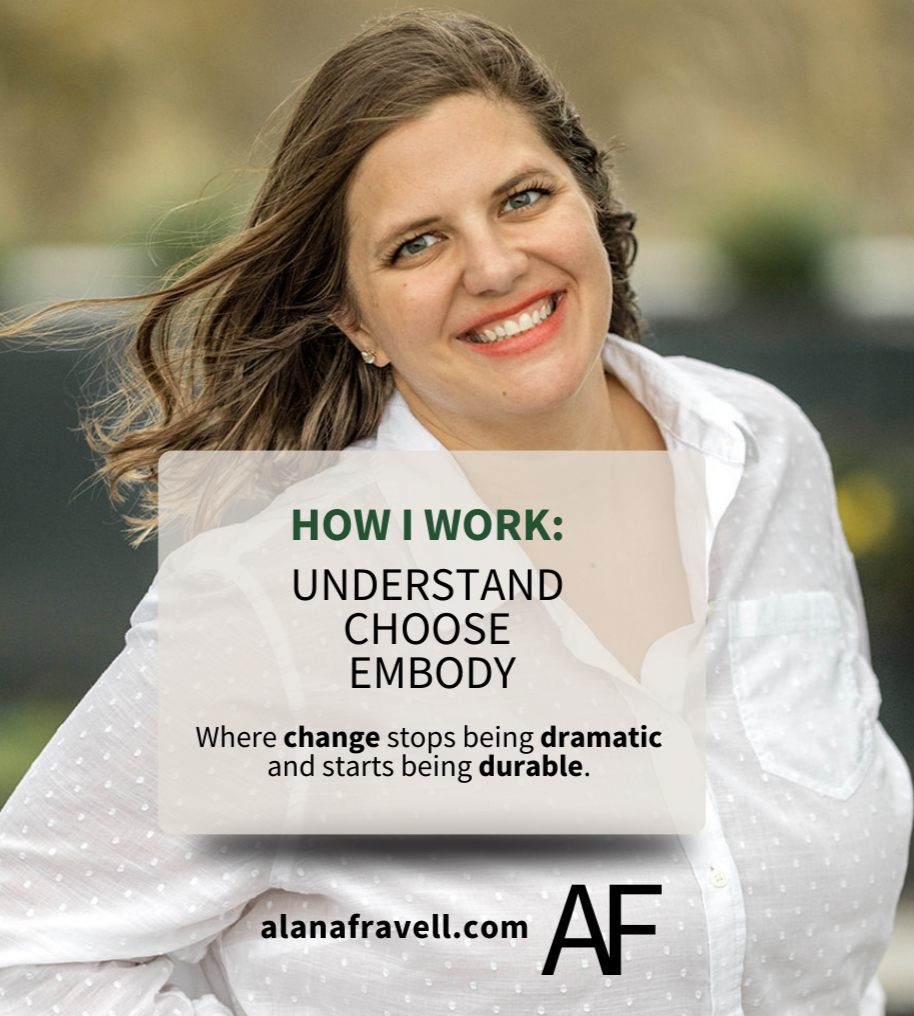
UNDERSTAND. CHOOSE. EMBODY.
First, you need to understand how human beings actually work - you deserve grace and compassion for why you are the way you are.
Then you practice choosing instead of reacting/defaulting - you get to do what you want to do!
Over time, those choices become embodied in how you live - following through to become the version of you that you want to be.
When those three build on one another, change stops being dramatic and starts becoming durable.
I help people understand themselves, reconnect with their own authority, and build lives that actually fit them. That does not require a rigid framework or a prescribed path.
It begins with reality: looking honestly at your patterns, your nervous system, your conditioning, and your lived context. From there, you begin noticing what genuinely belongs in your life and what does not. Then you practice alignment in small, steady ways your system can sustain.
The Pillars: UNDERSTAND. CHOOSE. EMBODY.
Pillar One: Understanding Human Nature
Everything begins with understanding.
Most people try to change their behavior through discipline or willpower. When those attempts fail, the assumption is often that something must be wrong with them.
But before trying to change yourself, it helps to understand how human beings actually work.
Most people arrive quietly asking some version of the same question: Why am I still like this?
Beneath that question is often shame, frustration, or private exhaustion from trying to override stubborn patterns. In other words, you have tried everything to get your life together, yet certain behaviors keep resurfacing.
You have insight. You have language for your patterns. You know your attachment style, your childhood themes, and your triggers. And yet the same reactions keep happening, especially in the moments that matter most.
You ignore red flags. You procrastinate on things that matter. You snap at your partner. You avoid applying for the promotion you want. You eat the food that makes you feel terrible. You promise yourself you will start exercising on Monday. You stay up until two in the morning scrolling your phone.
The frustration inside that loop often comes from believing that if you just tried harder or finally found the right solution, you would get it right and stop disappointing yourself.
The first shift in this work is reframing those patterns as human adaptations rather than personal defects.
Before responsibility comes context. Context creates clarity.
THE CONTEXT
You are not broken. You are a human organism shaped by biology, nervous system responses, conditioning, the need to belong, and lived experience. Much of your behavior is automatic, especially under stress, which is constant in today’s world.
Your brain and body learned early what felt safe, what felt threatening, and what preserved connection. Those strategies were intelligent. They worked. They helped you survive and stay attached - basic human needs.
Here is the difficult part to accept: just because you have grown up, your life circumstances have changed, or you intellectually understand your patterns, does not mean your survival strategies automatically update.
The deeper parts of your brain and nervous system continue running the programs that once kept you safe.
Your environment shaped you. It makes sense that you respond the way you do. Certain situations activate old wiring because your system learned long ago what to watch for and how to react. Insight and awareness alone rarely override those responses.
When you begin viewing your reactions through that lens, something shifts. Judgment loosens. Curiosity replaces it. Instead of asking why you cannot seem to change, you begin seeing how your system has been trying to protect you.
For many people, that realization brings relief. The internal fight softens. From that steadier place, growth becomes possible because it is no longer fueled by rejection of who you are.
GETTING STARTED:
Stop asking, “What is wrong with me?” or “Why am I still like this?”
Start asking, “What did my system learn, and does it still need to operate this way?”
That question creates space. And space is what makes real change and real choice possible. Give yourself grace for why you are the way you are now.
Pillar Two: Discernment Over Default
Once you start understanding how you are wired, a new question naturally appears: Do I actually want to keep living this way?
Most people never stop to ask it. They simply continue repeating the patterns they learned years ago. The job. The pace. The expectations. The goals handed to them by family, culture, or whatever industry convinced them this is what success is supposed to look like.
But awareness changes things. Once you see a pattern clearly, it becomes difficult to ignore. You begin noticing how many of your decisions were shaped by outside pressure rather than genuine preference.
Some of that pressure comes from caregivers. Some from media. Some from industries that make billions, convincing people they are behind, broken, or one purchase away from becoming a better version of themselves.
Modern life runs on that pressure. Work harder. Improve faster. Optimize everything. Buy the course. Follow the guru. Fix yourself. Here’s a product to do so!
These influences are loud. And if you are not careful, you start trusting those voices more than your own. The result is predictable. People stay busy, but they feel off. They keep striving, but nothing actually settles. There is always another goalpost. Discernment is where that cycle breaks.
It is the moment you stop asking “How do I do this better?” and start asking the far more disruptive question: “Do I even want this?”
Once you begin choosing what actually matters to you, a surprising amount of pressure disappears. Goals that once felt urgent begin to look optional. Expectations loosen. Your life stops running on autopilot.
Slowly, it begins reflecting who you actually are instead of who you were conditioned to be.
GETTING STARTED:
Part of discernment also involves reclaiming what I call the classics. Nature, nourishing food, genuine relationships, meaningful contribution, and grounded personal growth are not flashy, but they are stable. If you’re looking to reconnect with your inner compass, try spending some time with these fundamentals. They have the potential to regulate your nervous system and create clarity in a way endless optimization never will. Check out the full blog for ways to connect with the classics.
Pillar Three: Embodied Authenticity
Awareness and discernment mean very little if they never translate into consistent behavior. You can articulate your wounds, name your triggers, and explain your nervous system responses while still living in contradiction with yourself.
Embodied authenticity is the practice of closing that gap. It is the difference between understanding who you are and actually living in acceptance with that person in daily life.
It looks ordinary from the outside. Holding a boundary instead of rehearsing one. Resting without explaining yourself. Making decisions that reflect your values, even when they disappoint someone else.
Many people attempt change through criticism. They push themselves harder, judge their behavior, and try to force improvement through pressure. That approach usually fractures people internally, because the change is built on rejection of who they are.
Embodiment begins somewhere else: acceptance. You have to see yourself clearly without collapsing into shame or rushing to fix everything at once. When change grows from respect rather than criticism, it becomes far more sustainable. From that place, self-respect becomes practical. It shows up in boundaries, follow-through, honest conversations, and the pace at which you move through change.
Living this way will inevitably shift relationships. Some dynamics recalibrate. Some expectations fall away. Not everyone will prefer the version of you who is no longer performing. That discomfort does not mean you are wrong. Often, it simply means you are being honest.
Over time, your thoughts, nervous system, and behavior begin working together rather than against each other. Life feels less fragmented and more coherent.
GETTING STARTED:
When clarity appears, many people feel the urge to overhaul their entire life at once. That impulse is understandable, but rarely sustainable. Real change builds through small, consistent shifts.
Choose one thing. A sleep habit. A boundary. Leaving for work on time. Putting your phone down earlier. Brushing your teeth before bed. It does not matter what the behavior is. What matters is choosing something you can follow through on and actually doing it.
Consistency builds trust in yourself. And trust is what makes bigger changes possible later.
What I Believe and What I Do Not
I do not believe in quick fixes, personality overhauls, hacks, or one-size-fits-all healing plans.
I do not believe you are broken. And I do not believe anyone else holds the final answer to your life. External support can help you regulate, reflect, and integrate, but it cannot replace your internal authority.
My role is not to fix you. It is to help you hear yourself more clearly.
Most change fails because it skips the foundation. People try to force transformation without understanding themselves, regulating their nervous system, or practicing self-compassion.
I believe context is more powerful than criticism. I believe integration matters more than collecting insight. And I believe sustainable growth happens through small, deliberate shifts repeated over time.
Integrity feels better than performance, even if it takes longer to build.
How We Work Together
In practice, this work often includes nervous system support through Reiki sessions, reflective conversations, and coaching containers that help translate insight into action.
Regulation creates the conditions for clarity. Clarity makes aligned decisions possible. We slow things down enough for you to actually feel what is happening instead of sprinting past it. My goal is not to make you dependent on me for growth and healing. It is to help you trust yourself more deeply.
When your body feels safer, your thinking becomes clearer. When your thinking becomes clearer, your choices become more deliberate. And when your choices align with who you are, your life begins to feel coherent rather than fragmented.
If You Are Just Beginning
Please know that wherever you are right now is ok. Give yourself grace; you did what you did with the knowledge and skills you had at the time.
Start with understanding. Learn how your nervous system works. Notice your patterns without turning them into indictments. Then practice discernment in one small area of your life. Choose something based on how YOU think and feel, NOT how you think you should. Finally, choose behaviors that reflect who you actually are - and repeat them consistently.
This is not about reinventing yourself. It is about removing what is not you and strengthening what already is.
When you see clearly, choose deliberately, and live accordingly, something steadies. Your life begins to fit. And when your life fits, growth stops feeling like performance and starts feeling like integrity.
Why I Do This Work and How I Was Led Here
I am a holistic energy practitioner, a wife of ten years, a dog mom, a trauma-for-days recovering perfectionist who spent many years trying to fix herself.
I cycled through diet changes, self-care routines, therapy, astrology, coaching, retreats, numerology - anything that promised relief. I kept assuming the next method would finally fix me.
What I eventually realized was that I had been outsourcing my healing.
A qigong experience at a trauma-healing retreat shifted something for me. The energy I had felt in my body for years was no longer something to suppress or analyze. It was something to work with. That experience led me toward Reiki, somatic practices, and spending more time in nature as ways to understand the tension I had carried for most of my life. The more I allowed myself to feel what was actually happening inside me, the more things began to reorganize.
I eventually became a Level 2 Usui Tibetan Reiki practitioner and a Certified Self-Care Coach - not because I found a magic solution, but because I found a path to connect with and get to know my true self.
This work did not give me a dramatic breakthrough. It gave me steadiness. That steadiness made space for real healing.
Today, I support adults who feel overwhelmed, burned out, or quietly disconnected from themselves. Many have spent years performing competence for everyone else and are finally asking what they want.
I am not here to promise transformation on a timeline.
I am here to offer grounded space. A place where your nervous system can soften, where your patterns make sense, and where your next steps come from clarity instead of pressure.
If you are ready to understand yourself, choose deliberately, and live accordingly - this is the work.
I’m so glad you’re here.
💚Alana
See ways to work together here.
FAQ: Understanding Yourself and Creating Real Change
What does “understanding human nature” mean in personal growth?
Understanding human nature means recognizing that many of your reactions, habits, and emotional patterns developed for a reason. Instead of shaming yourself for them, you begin to understand how your nervous system, life experiences, and conditioning shaped your behavior. This awareness creates the foundation for meaningful change.
Why is self-awareness not enough for real change?
Self-awareness helps you see your patterns, but insight alone rarely changes behavior. Real transformation happens when awareness is followed by intentional choices and consistent action. In other words, you move from understanding yourself to actively living in alignment with what you know.
What is discernment in personal development?
Discernment is the ability to pause, evaluate, and choose intentionally rather than reacting automatically. It allows you to notice when an old pattern is running and decide whether that response still serves you.
What does it mean to embody authenticity?
Embodied authenticity means living in alignment with your values, needs, and internal signals. It shows up through boundaries, honest communication, and decisions that reflect who you actually are rather than who you feel pressured to be.
Why does personal growth take [so much] time?
Most of our patterns formed over many years through lived experiences, relationships, and conditioning. Because those patterns are deeply ingrained in both the mind and body, lasting change tends to happen through gradual awareness, practice, and integration rather than quick fixes.
How can Reiki support personal growth and self-awareness?
Reiki works with the body’s energy system to help regulate the nervous system, reduce stress, and create a sense of internal safety. When your system is calmer and more regulated, it becomes easier to notice patterns, access clarity, and make aligned choices in your life.
Can Reiki help with emotional healing or stress?
Many people use Reiki as a supportive practice for emotional regulation, stress relief, and reconnecting with themselves. While it is not a replacement for medical or psychological care, it can be a powerful complementary practice for grounding and integration.
How can I book a session with you?
If this approach to personal growth resonates with you, Reiki sessions and coaching can be a supportive place to slow down, reconnect with yourself, and integrate what you are learning.
You can learn more and book a session here.